
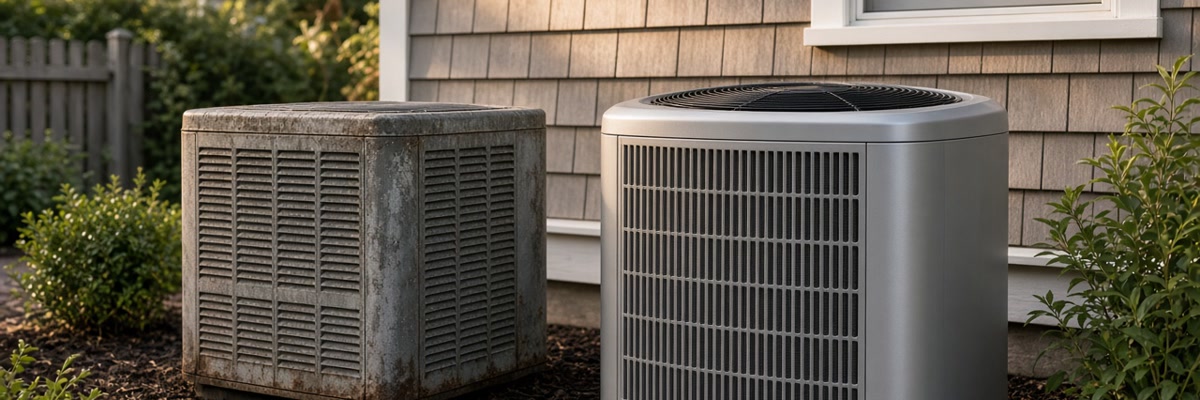
When an HVAC system breaks down, the first question is usually simple: should I repair it or replace it? For Greenwich homeowners, the right answer depends on the age of the equipment, the type of failure, the condition of the rest of the system, and whether the repair actually solves the underlying problem.
At Greenwich HVAC, the goal is not to make replacement the default answer. A good contractor should troubleshoot first, explain what failed, and help you understand whether a repair is practical or whether replacement is the more reliable long-term decision.
Start with the real problem, not the sales pitch
Some HVAC problems are straightforward repairs: a failed capacitor, a weak contactor, a clogged condensate line, a dirty coil, a control issue, or a bad thermostat connection. Other problems point to larger system wear, poor airflow, refrigerant issues, repeated failures, or aging equipment that is becoming harder to support.
The important thing is to diagnose the system before making a decision. Replacing equipment without understanding the cause can waste money. But repeatedly repairing an old, unreliable system can also become expensive and frustrating.
When repair may make sense
- The system is relatively young and has been maintained.
- The repair is isolated and the rest of the system is in good condition.
- Parts are available and the repair cost is reasonable.
- The system has not had repeated breakdowns.
- The repair restores safe, reliable operation.
In these cases, a repair-first approach can be the right choice. Many homeowners simply need honest troubleshooting, not a premature replacement recommendation.
When replacement may be the better decision
- The system is older and has recurring failures.
- Major components are failing or parts are becoming difficult to obtain.
- The system is inefficient, noisy, or unable to keep the home comfortable.
- Repair costs are climbing close to the value of replacement.
- The system has safety, reliability, or support concerns.
Replacement can make sense when it improves reliability, comfort, efficiency, and warranty protection. The decision should be explained clearly, with the repair option discussed honestly whenever it is realistic.
Look at the full system
For air conditioning, the outdoor condensing unit, indoor air handler or coil, ductwork, airflow, controls, and refrigerant condition all matter. For heating, the boiler or furnace, pumps, piping, controls, venting, and distribution system all affect the outcome.
A repair on one part of the system may not solve comfort problems if the underlying issue is airflow, controls, poor maintenance, or mismatched aging equipment.
Maintenance changes the repair-or-replace conversation
Regular maintenance helps catch small issues before they become major failures. It also gives homeowners a clearer picture of equipment condition over time. A well-maintained system with a known service history is easier to evaluate honestly.
Greenwich HVAC’s Preventative Maintenance Agreement can help with routine maintenance reminders, priority service, 10% off service and replacement-related work, and stronger warranty support for active/continuous PMA customers, subject to agreement terms.
Questions to ask before deciding
- What exactly failed?
- Is this a one-time issue or part of a pattern?
- Are parts available?
- What is the expected life of the system after repair?
- Would replacement solve comfort or reliability issues that repair will not?
- What warranty applies to the repair or replacement?
These questions help homeowners make a practical decision instead of reacting under pressure.
Helpful homeowner resources
- U.S. Department of Energy: Air Conditioner Maintenance
- U.S. Department of Energy: Heat Pump Systems
- Connecticut License Lookup
Need honest repair-or-replace guidance?
If you are trying to decide whether to repair or replace an HVAC system in Greenwich, call Greenwich HVAC at 203-531-7511. We will help you understand the problem, the practical options, and the best path for your home.